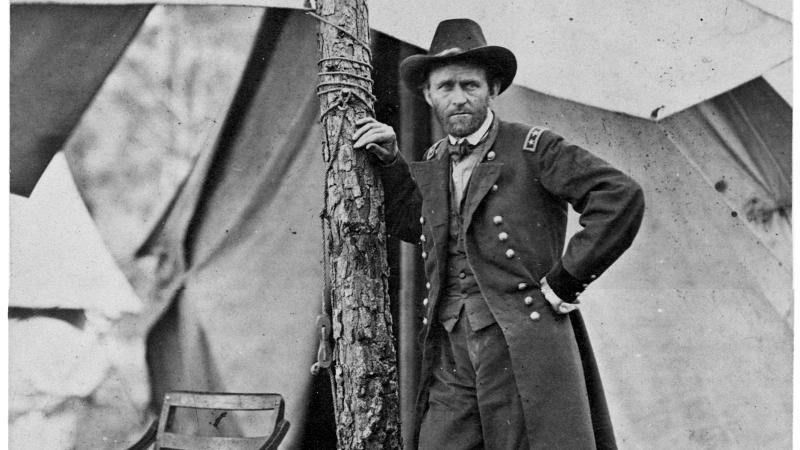
“The great distinguishing qualities of General Grant were truth, courage, modesty, generosity and loyalty. He was loyal to every work and every cause in which he was engaged.” – Major General Grenville Dodge
“Nobody could watch [Grant] without concluding that he was a remarkable man. He handles those around him so quietly and well, he so evidently has the faculty of disposing of work and managing men, he is cool and quiet; almost stolid … and in a crisis he is one against whom all around, whether few in number or a great army … would instinctively lean. He is a man of the most exquisite judgment and tact.” – Charles Francis Adams, Jr.
“I can’t spare this man. He fights.” – Abraham Lincoln
I think many of us are trying to find leaders and role models that can help us through these disparate times. At least, I know I am.
We want someone who we know is flawed but keeps moving forward anyway. We want someone who is tough, yet kind and loving. We want someone who puts others before themselves. We want someone who does the right thing, even if it is to their own personal detriment. Rare it seems these leaders are who rise to the levels we need them to be.
As a student of history, I continue to find myself looking backwards in an attempt to make sense of the present. History isn’t so much a mirror as much as a reflection pool. The murky and wobbly reflection isn’t so much us as a muddled version of what we were. Many of us refuse to acknowledge that all of this has happened before, and it will all happen again, so in a desperate attempt to know what is, we look forward to what can be.
As I look into the past, I became reacquainted with an historical figure I didn’t expect – Ulysses S. Grant, the Civil War hero and 18th president of the United States.
It is a damn shame that the USA of today has almost forgotten this man. Thanks to the notorious “Lost Cause” mythology, Grant has been maligned, reduced, and forgotten. There was a time when the three pillars of American heroism, as described by Theodore Roosevelt, were Washington, the Founder; Lincoln, the Martyr; and Grant, the Savior. Today? Few know much about Grant other than overexaggerations of his drinking and misnomers about his corrupt presidential administration.
No. This man is more than that. He deserves our admiration and immolation.
Ulysses S. Grant is a tragic Americanhero who deserves his place on Mount Rushmore. The tragedy is one of a man of unwavering moral conviction and perseverance who achieved greatness but bore the heavy cost of leadership, misunderstanding, and personal flaw. To understand why we should admire him despite his shortcomings is to embrace the complexity of human nature, especially when that nature is forged in the crucible of civil war, national reconstruction, and personal struggle.
Grant’s early life was marked by failure. He struggled in business, was demoted in the military due to accusations of drinking, and was largely seen as unremarkable before the Civil War. But in war, he found his calling – not because he sought glory, because he didn’t. He found his calling because he saw duty. His rise from a man selling firewood on street corners to Commanding General of the U.S. Army is one of the most dramatic arcs in American history.
As president, Grant’s administration was plagued by scandal – not because of personal greed, but because of his tragic loyalty. He trusted old friends who betrayed him and tarnished his name. This loyalty, a virtue in private life, became a flaw in public leadership. Yet, Grant personally remained uncorrupted, committed to civil rights, and uniquely advanced the cause of Black Americans during Reconstruction. He used federal power to fight the Ku Klux Klan, even when the political cost was high.
Grant is considered by many historians to be the first Civil Rights president. He genuinely wanted to bind the nation’s wounds, and he saw advancement of Black rights as pivotal to the future of the nation. Unfortunately, America’s political and social will to carry Reconstruction through to fruition was weak. He stood almost alone at times defending Black suffrage, education, and political participation. His efforts were ultimately undone by systemic racism and a weary nation. That failure – largely out of his hands – became his burden. He carried the guilt of what could not be achieved till his death.
Grant possessed a kind of stoic resilience. He was unshakable in battle, often calm under pressure when others panicked. His personal modesty, disdain for pomp, and quiet demeanor masked a will of iron. Even after his presidency, when he lost all his money to a Ponzi scheme and learned he had terminal throat cancer, he committed himself to writing his memoirs – not to save his reputation, but to provide for his family. He died a mere three days after completing them.
Mark Twain, who published the memoirs, called them a masterpiece. They remain a pillar of American literature and a final gift from a man who never stopped trying to serve others, even in death.
Ulysses S. Grant’s leadership is a vital example of moral courage and human decency in American history—especially meaningful today, when doing the right thing often clashes with political or financial convenience. Grant wasn’t perfect, but his actions, especially during and after the Civil War, reflect a profound commitment to justice, fairness, and humanity.
Other amazing stories that help paint the picture of an honorable man worth admiring:
1. He Freed an Enslaved Man, Even While Destitute
One of the most striking examples of Grant’s moral integrity came in 1859. Living in poverty, he was given a man named William Jones, who was enslaved. Instead of selling Jones – an act that could have provided critical income for his struggling family – Grant chose to free him. At a time when many would have made the opposite decision, Grant submitted papers of manumission, officially granting Jones his freedom.
Grant was not yet a famous general or political leader. He was a man with a family to feed. His decision to prioritize a man’s freedom over money shows extraordinary ethical conviction.
2. Inclusion and Respect for Native Americans: The Case of Ely S. Parker
Grant appointed Ely S. Parker, a Seneca Native American and Union officer, as his military secretary. Parker was a full-blooded Native American who had faced racism and rejection when trying to serve in the Union Army. Grant recognized his talent and character. It was Parker who penned the official terms of surrender signed by General Robert E. Lee at Appomattox Court House in 1865.
When Lee reportedly remarked, “I’m glad to see one real American here,” Parker is said to have replied, “We are all Americans.”
In an era of widespread racism (not to mention genocide) against Native Americans, Grant gave Parker not only a role, but a position of deep trust and historical significance.
3. As President, He Fought for Civil Rights and Reconstruction
Grant’s presidency (1869–1877) is often remembered for corruption scandals among appointees, but it also deserves credit for strong civil rights actions:
- Crushed the Ku Klux Klan with the Enforcement Acts, using federal power to protect Black citizens and suppress white supremacist violence.
- Supported the 15th Amendment, giving Black men the right to vote.
- Appointed African Americans to public office.
- Used federal troops to enforce Reconstruction and protect freedmen.
Grant understood that ending slavery wasn’t enough. It had to be followed by meaningful action to protect civil and voting rights. He was willing to take unpopular stances and use federal power to uphold justice.
4. His Memoirs Show a Man of Principle and Reflection
In his final years, dying of throat cancer and facing bankruptcy, Grant wrote his Personal Memoirs to provide for his family. The memoirs are widely regarded as among the finest by any American president. They reveal a man who was thoughtful, humble, and honest – not seeking revenge or embellishment.
Grant’s character comes through clearly in his writing. He was a man of action, but also of introspection. He was a leader who cared deeply about his country and its future.
Why I Admire Grant
This modern American era is not unlike Grant’s – division, partisanship, and moral ambiguity dominate headlines. Ulysses S. Grant, however, stands as a reminder that leadership rooted in human dignity, ethical clarity, and inclusive vision still matters.
Grant chose freedom over profit, trusted and empowered those society marginalized, protected the vulnerable through the law and executive action, and lived—and died—with integrity.
He reminds us that greatness is not perfection. His flaws – naiveté in politics, potential alcohol abuse, excessive trust – are real. But his virtues – courage, perseverance, empathy, justice – are just as real and, more importantly, enduring. He stood for union, for equality, for peace. He struggled with personal demons and national chaos and still chose to lead with conviction.
In this way, Grant is a tragic but admirable figure, a man who, despite his limitations, gave everything he had for his country and its people – all of its people. He deserves not only our understanding—but our respect.
His leadership was not just military or political – It was moral. And that’s the kind of leadership the world needs more of today.
© 2025 HR Philosopher. All rights reserved.
 The HR Philosopher