When will this nightmare be over? Tell me
When can I empty my head?
Will someone tell me the answer?
Is God really dead?
— God Is Dead?, Black Sabbath, 2013
SHRM has been hit with wave after wave of bad news lately with the recent news crescendo of them having been hit with an $11.5 million verdict in a racial discrimination lawsuit.
This is a long time coming… from ethical questions, political controversies, leadership concerns, and a growing sense among HR professionals that the organization meant to be our north star may have lost its way. Many in the profession feel betrayed. Many feel at least disoriented. HR practitioners across the country are asking themselves: If the flagship institution of our field is faltering, what does that mean for us?
I felt this as well. And to answer that, I do what I usually do. I turn to philosophy, but this time I sought out a surprising guide: Friedrich Nietzsche.
Nietzsche was a revolutionary thinker whose critique of morality, culture, and meaning reshaped modern philosophy. Yet, his most famous concepts were often misunderstood or misused, obscuring the depth and subtlety of his actual ideas.
Specifically, “God is dead”—one of his most famous philosophical musings—is misunderstood because Nietzsche wasn’t bragging about killing God or celebrating atheism; he was diagnosing a cultural crisis. He meant that the traditional, Christian foundation of morality and meaning had lost its power over modern Europe, leaving a void of purpose and shared values. For Nietzsche, this was dangerous. It was not a victory because without that foundation, people could fall into nihilism unless they took up the hard task of creating new, life-affirming values for themselves and their societies.
It may seem odd to bring Nietzsche into HR, but his philosophical work, especially his provocative declaration that “God is dead,”offers a clear framework for moments exactly like this: moments when a once-dominant authority collapses, leaving a vacuum that feels terrifying but is also ripe with creative possibility.
What Nietzsche Meant by “God Is Dead” (And Why It Matters for HR)
Again, Nietzsche’s famous phrase is often misunderstood. He wasn’t declaring a theological position, nor celebrating destruction. He was diagnosing a cultural reality:
A foundational institution people relied upon had lost credibility and no longer held the moral authority it once did.
In Nietzsche’s world, traditional systems such as churches, moral codes, and inherited values were losing power. Society faced an existential crisis: If the old authorities no longer guide us, what comes next?
Nietzsche believed that when a guiding institution collapses, people face two options:
- Despair and nihilism (“Nothing matters anymore.”)
- Revaluation and rebirth (“If the old models no longer serve us, we must create new, stronger ones.”)
Sound familiar?
Today, many HR professionals feel lost, for a lot of reasons, but certainly, in part, because the institution that was supposed to shape and elevate our profession is under intense scrutiny. The old authority no longer provides the clarity, trust, or inspiration it once did.
In Nietzsche’s framing, this moment is not the end. It is the beginning of responsibility. When the old gods fall, we are called to build new structures, new ethics, and a new vision.
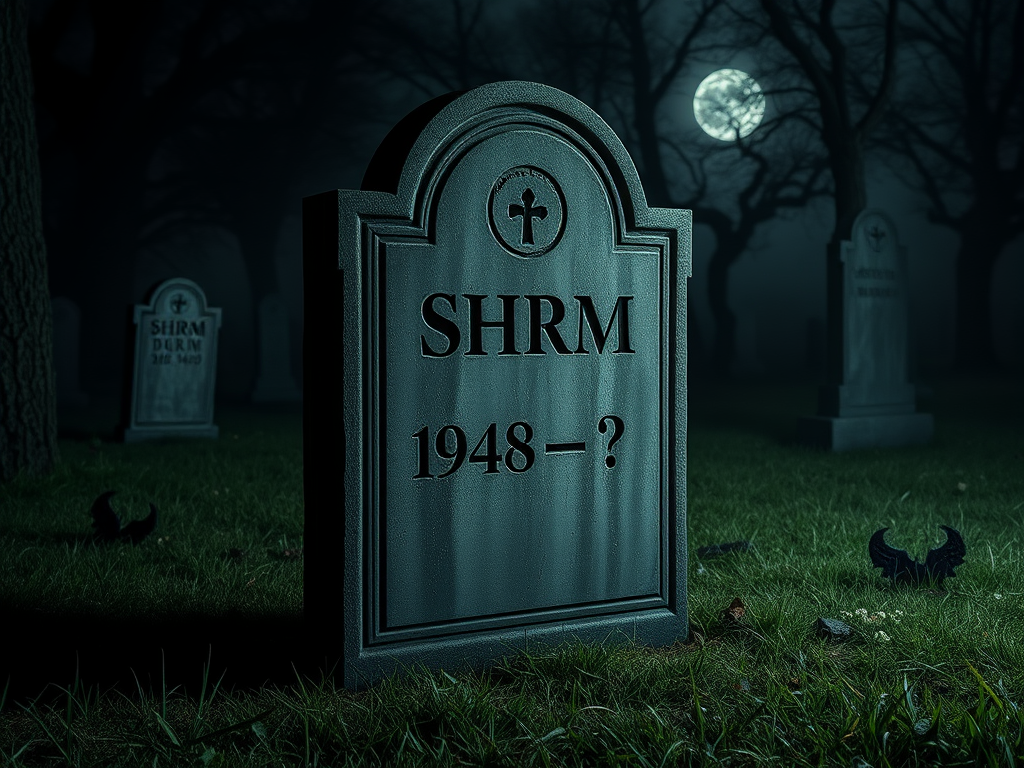
So… Is SHRM Dead?
If we apply Nietzsche’s logic, the real question isn’t whether SHRM as a corporation continues to exist. It likely will. Structures rarely disappear overnight.
The question is:
Has SHRM lost the moral authority to define the HR profession?
Many HR leaders feel the answer is yes. The perception is that SHRM has become:
- Out of touch with the real work of HR
- Politically entangled with horrible people
- Commercialized and corporatized (profits over people!)
- Focused more on brand than on elevating the profession (especially the brand of their CEO)
- Slow to respond ethically or transparently when controversies arise
Even longtime members have been asking, “Does SHRM still speak for us? Represent us? Inspire us?”
When a body that once held symbolic power loses its credibility, a kind of Nietzschean “death” occurs. Not a literal end, but the collapse of trust, authority, and moral leadership.
And Nietzsche would say: Good. Because only when the old idols crumble can something better emerge.
The HR Profession Now Stands in a Nietzschean Moment
SHRM’s crisis is not just a PR problem. It’s an identity crisis for HR itself, or at least it is for a lot of its remaining members. Many left SHRM years ago. However, those who were awakened by SHRM’s wrongs years ago cannot discount that many people within HR still look to the body for inspiration.
What’s worse is that many NOT in the field look to SHRM as an authority because they don’t know better. CEOs looking to hire an HR pro probably don’t know any better, so they assume the SHRM credentials and tags on a resume mean more than they likely do.
SHRM is dying, but Nietzsche teaches us that collapse is a creative force.
When he spoke of the “Übermensch” (often mistranslated as “superman”), he was describing a person or culture that rises beyond inherited systems and creates its own values. These new systems are rooted in courage, accountability, creativity, and self-overcoming.
A quick note: I need to address the elephant in the room. I am invoking Nietzsche and interpreting his terms as he meant them, not as they were later twisted and corrupted. I’m fully aware of the problems with a term like Übermensch, especially in today’s precarious climate of rising racism, jingoism, nationalism, and hatred. But that’s exactly why we need to go back to the source. Nietzsche wasn’t talking about racial supremacy; he was pushing us toward self-transcendence, courage, and creating values that affirm life and dignity. If we can recover that deeper meaning, we can use his work to challenge injustice…. not to fuel it.
So, SHRM is dying, if it’s not already dead. This is precisely the opportunity HR has to create a new system to replace the old world.
Without SHRM acting as the unquestioned authority, HR professionals can:
- Rebuild the field around ethics, courage, and people-centered leadership
- Demand better from institutions that claim to represent us
- Form new communities and collectives
- Reimagine certification and development models
- Push for HR to be truly transformational, not merely transactional
- Reground HR in humanity, not bureaucracy
The fall of one institution does not doom the profession. It frees the profession.
From the Ruins: A Stronger HR Is Possible
Nietzsche believed that destruction alone is useless. The point is what we build after.
If SHRM is experiencing its “death of god” moment, HR has a responsibility—a creative obligation—to ask:
- What should HR stand for?
- How do we define professionalism and ethics?
- What does leadership look like in an age of inequality, injustice, and organizational trauma?
- What are the values HR must hold when institutions fail?
- How do we become builders rather than bureaucrats?
A post-SHRM HR could be:
- More human: Focused on dignity, fairness, wellbeing, and purpose.
- More courageous: Willing to challenge leaders, stand up to harmful behaviors, and advocate for equity.
- More ethical: Guided by transparent, principled frameworks—not politics or profit.
- More community-driven: Where HR professionals shape the field together, not top-down from a corporate office.
- More philosophical: Understanding the deeper meaning of leadership, culture, and the human condition.
Oh, and we can FINALLY put the “equity” back in DEI! I will never forgive SHRM for that garbage, bootlicking take. But I digress, somewhat.
Nietzsche’s message wasn’t despair. His message was empowerment. When the old structures crumble, we are free to build anew.
SHRM May or May Not Recover. But HR Will Evolve.
Whether SHRM reinvents itself or fades into irrelevance is still an open question. But the profession will not die with it.
In fact, this moment might be the most important thing to happen to HR in decades.
We get to redefine ourselves.
We get to rebuild from the ruins.
We get to create the HR profession we should have had all along.
As Nietzsche wrote, “One must still have chaos in oneself to give birth to a dancing star.”
The chaos around SHRM is not the end of HR. It is the moment before the rebirth of a more powerful, people-centered, ethically grounded HR movement.
And perhaps—just perhaps—the dancing star is already forming.
© 2025 HR Philosopher. All rights reserved.
 The HR Philosopher